

How should plush slippers fit?
Plush slippers should feel gently secure around your foot, with room to move your toes and no squeezing across the top or sides. Your heel should stay supported by the footbed, and you should be able to walk without curling your toes to keep the slippers on; soft lining does not make up for the wrong size.
- Plush slippers should feel secure, not tight, with room for your toes to move naturally.
- Check both feet while standing and walking, wearing the socks you plan to use at home.
- Omniora’s Soft-Lined Slippers suit indoor wear; fit still depends on your foot and the product’s size guidance.
- Choose cozy loungewear and sleepwear separately; matching softness does not mean matching size.
Why this matters
A slipper can feel wonderfully soft while you sit down, then feel awkward when you stand. The lining is only part of comfort. Length, width, and how the slipper stays on your foot matter too.
For your 2026 comfort shopping, start with how you will actually wear the pair. Bare feet after getting dressed and warm socks on a quiet evening need different amounts of space. If your home wardrobe changes with the weather, use the same practical approach when choosing cozy loungewear for changing seasons.
Choose the fit you can walk in comfortably, not the softest pair you can squeeze into. A calmer evening starts with something you do not need to keep adjusting.
How should plush slippers fit?
Plush slippers should hold your foot without pressing your toes together, pinching the sides, or making you grip with your toes. Check them while standing, because a pair that feels roomy when you are seated can feel different under your weight.
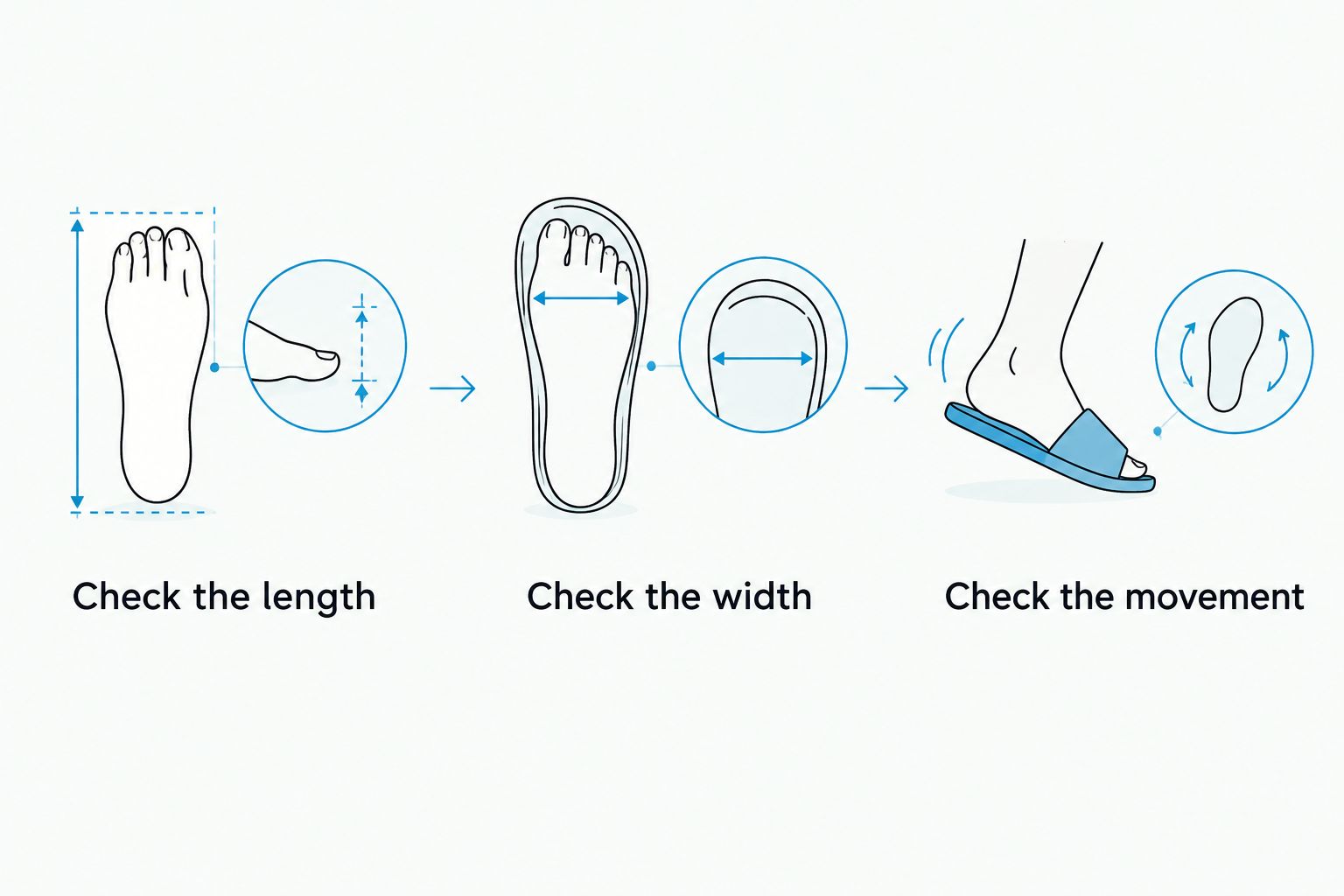
Use this simple try-on sequence:
- Check the length. Set your foot naturally on the footbed. Your toes should not press against the front, and your heel should not hang over the back edge.
- Check the width. Notice pressure along the sides and across the top. A close, soft feel is different from squeezing or a seam digging into your foot.
- Check the movement. Walk naturally and turn around. The slippers should follow your feet without repeated slipping, dragging, or toe gripping.
Try both slippers, not just one. Notice whether either foot feels crowded, and do not let a good fit on one side excuse discomfort on the other.
There is no universal toe-gap measurement that works for every slipper shape and lining. Follow the product’s size guidance, then judge the actual fit with your feet in their normal position.
What a comfortable fit feels like
A comfortable slipper lets your toes rest rather than bunch up. Your foot feels settled, but you can move it naturally. The upper does not need to feel loose to feel cozy.
Look for comfort across the whole foot. Extra length at the front does not fix a narrow upper, and a generous width does not fix a heel hanging off the footbed. Length and width must both work.
What a poor fit feels like
A poor fit gives you something to manage: pressure, rubbing, sliding, or a need to hold the slipper on. Do not treat those signs as the price of a soft lining.
Check the pair again if you keep changing your stride. A slipper that only stays on when you shuffle is not passing the walking check.
Closed-back slippers: secure without rubbing
Closed-back slippers should sit around your heel without digging into it. Some movement during a step is different from your heel repeatedly lifting out of the slipper. Judge whether the pair stays with your foot as you walk.
Best for: shoppers who prefer a heel enclosure rather than an open back. The benefit is that enclosing shape; the trade-off is another contact point to check for pressure or rubbing.
Do not choose a shorter size simply to eliminate all heel movement. If that pushes your toes against the front, you have traded one fit problem for another. Look for a shape that works at both ends.
Open-back slippers: keep your heel on the footbed
Open-back slippers should support your heel on the footbed without leaving it over the edge. The upper should hold the front of your foot comfortably enough that the slipper follows your step.
Best for: shoppers who like to slip footwear on and off without a heel enclosure. Easy entry is the benefit; the trade-off is that the front fit must work without a back holding the slipper in place.
An open back is not a reason to accept an undersized footbed. It is also not a reason to accept a pair that slides away whenever you lift your foot.
| Slipper style or wearing choice | Best for | Comfortable fit | Benefit | Trade-off to check |
|---|---|---|---|---|
| Closed-back slippers | A heel-enclosing feel | Heel stays comfortably within the back | Encloses the heel | Back edge can rub if the shape is wrong |
| Open-back slippers | Easy on-and-off wear | Heel rests fully on the footbed | No heel enclosure to step into | Front fit must keep the slipper with your foot |
| Slippers worn barefoot | Direct contact with the lining | No irritating seams or pressure | Lets you judge the lining directly | A fit that works barefoot can feel tighter with socks |
| Slippers worn with socks | Your usual sock-and-slipper routine | Comfortable with your intended socks | Matches how you actually wear the pair | Sock thickness changes the space inside |
Why plush slipper fit varies
The size label is a starting point, not a complete description of the fit. When choosing plush slippers in 2026, compare the shape and intended use as carefully as the softness.
- Lining thickness. Plush lining occupies space inside the slipper. Judge the usable space around your foot, not just the outer shape.
- Toe shape. A rounded outline does not prove there is enough width for your toes. Check where the toe area narrows.
- Upper coverage. An upper that sits farther across your foot creates a different contact area from a more open design.
- Heel design. Open and enclosed backs hold the foot differently. Each needs its own walking check.
- Sock choice. The socks you intend to wear belong in the try-on. Do not test barefoot if your normal routine includes thicker socks.
- Foot shape. Your usual shoe size cannot describe every part of your foot. Look for pressure across the top and sides as well as at the toes.
These factors explain why sizing up is not always the answer. If a larger pair removes pressure but slips off, the shape still does not suit your foot.
Should plush slippers be tight at first?
Plush slippers should not feel tight enough to squeeze, pinch, or force your toes into a cramped position. A soft, close fit is fine; uncomfortable pressure is not a useful starting point.
Do not buy a painful fit on the assumption that the lining will settle. How a particular slipper changes with wear depends on its construction. Choose comfort now rather than relying on an unverified promise about later.
Should you size up in plush slippers?
You should size up only when the product’s size guidance and your fit check support the larger size. Plush slippers do not all use the same dimensions, so an automatic size-up rule does not work across every pair.
If you are between sizes, compare the stated measurements and try the intended socks. If the larger size slides while the smaller size squeezes, look for a different shape rather than forcing either choice.
How should plush slippers fit with socks?
Plush slippers should feel secure and roomy enough for your toes while you wear your usual socks. Socks should not turn a comfortable upper into a tight band across the foot.
For a 2026 cold-weather purchase, test the socks you actually reach for at home. If you switch between barefoot wear and socks, check both and decide which use matters most.
Choosing an indoor pair for your evening routine
Omniora plush slippers are best for shoppers choosing soft footwear for everyday indoor comfort. Choose between the verified features below, then check the size guidance for the specific pair. A rounded toe or soft insole does not establish your personal fit.
| Product | Best for | Verified features | Practical benefit | Limitation |
|---|---|---|---|---|
| Soft-Lined Slippers | Indoor wear with a sponge insole | Rounded toe, sponge insole, rubber sole | Includes a soft insole for everyday house wear | These features do not establish width, fit, or grip performance |
| Thick-Soled Plush Slippers | Indoor wear with a plush upper | Rounded toe, plush upper, flat EVA sole | Combines a plush upper with an indoor-wear design | The title does not provide a measured sole thickness or prove support |
Choose Soft-Lined Slippers if the sponge insole is the feature you want. Choose Thick-Soled Plush Slippers if the plush upper and flat EVA sole match your preference. Neither description replaces a size check.
For either pair, confirm the listed measurements and care instructions before choosing. Do not infer outdoor suitability, washing methods, or a particular level of cushioning from the product name alone.


Pairing slippers with sleepwear and loungewear
Choose slippers around your feet, then choose sleepwear or loungewear around the rest of your routine. A coordinated look is pleasant, but matching labels do not establish matching fit.
For your 2026 evening wardrobe, check garment measurements separately from slipper measurements. Notice whether your lounge trousers interfere with your steps, too. Your clothing and footwear should feel easy together without needing constant adjustment.
Omniora’s comfort essentials cover sleepwear, bedding, and cozy home items. Keep each purchase practical: footwear that fits, clothing that feels comfortable, and home accessories suited to where you will use them.
Buying plush slippers as a cozy gift
For a 2026 cozy gift, ask for the recipient’s usual size and whether they wear slippers with socks. Better still, check the measurements from a pair they already find comfortable. A size label alone leaves more room for a mismatch.
Choose for the recipient’s routine rather than your own. Someone who prefers an enclosed heel needs a different fit check from someone who enjoys an open-back pair. Softness is a thoughtful starting point, not the whole decision.
Before gifting, check the stated return or exchange policy without assuming what it includes. If you cannot establish the recipient’s footwear size, consider a comfort gift that does not require a foot-size match.
FAQ
How should plush slippers fit around my toes?
Plush slippers should leave your toes comfortable and able to move naturally. Your toes should not press against the front or feel squeezed together at the sides.
Are plush slippers supposed to feel snug?
Plush slippers should feel gently secure, not tight. A close upper is comfortable only if it does not pinch, rub, or restrict your toes.
Should my heel hang off open-back slippers?
Your heel should rest on the footbed rather than hang over the back edge. An open-back design changes how you put the slipper on, not how much footbed your heel needs.
Should I buy plush slippers bigger than my shoe size?
Do not automatically buy plush slippers bigger than your shoe size. Follow the specific product’s size guidance and check the fit with the socks you intend to wear.
Is it okay if my slippers slip when I walk?
Repeated slipping or toe gripping is a sign to reassess the fit. Check the upper, length, and heel design rather than accepting a pair that changes your natural walk.
Can I wear thick socks with plush slippers?
You can wear thick socks with plush slippers if the combination stays comfortable and secure. Try that combination before deciding on a size, because socks take up space inside the slipper.
How do I choose plush slippers as a gift?
Choose plush slippers using the recipient’s size, preferred heel style, and usual sock choice. Check the product’s measurements and the stated return or exchange policy before buying.
One last thing
The most revealing fit check is what your toes do while you walk. If they keep curling to hold the slipper on, reconsider the pair even when the lining feels lovely.
Let comfort be quiet. A well-chosen slipper stays with your foot, leaves your toes at ease, and lets you settle into your evening without another adjustment.